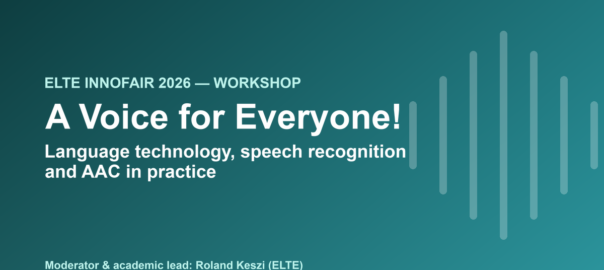
We are taking part with the organisation of a professional workshop at ELTE Innofair 2026, Eötvös Loránd University’s flagship event showcasing its innovation and industry relations. At the event, we aim to demonstrate – through CONCRETE, PRACTICAL PROJECTS – the gaps between language technology research, its industrial applications, and everyday use, placing special emphasis on the perspectives of people with speech impairments and disabilities. I am the initiator, professional lead, and moderator of the workshop.
In the workshop we present some of the practical, industrial applications of speech technology, while also demonstrating the academic and research background of the field. The professionals giving the talks have many decades of experience and an academic background in the fields of data science, artificial intelligence research and application, and language technology.
Would you like to join the workshop?
The project aims to support people with speech impairments through language technology and automatic speech recognition. The workshop reviews the related language technology developments and challenges, on 30 September 2026, at the ELTE Lágymányos Campus.
What is AAC?
AAC (Augmentative and Alternative Communication) is an umbrella term for the methods and tools that enable expression for people who communicate without speech or with limited speech – for example, people with certain motor or intellectual disabilities, autism spectrum disorder, aphasia, or dysarthria. This includes picture-based communication boards as well as eye-gaze- or touch-controlled digital text-to-speech applications. Advances in language technology and automatic speech recognition have significantly expanded the possibilities of AAC tools in recent years, especially for accessible Hungarian-language solutions – such as the Talkie application presented at the workshop.
Workshop programme
- Automatic speech recognition – general overview and industry outlook – Tibor Fegyó and co-authors (Budapest University of Technology and Economics – Faculty of Electrical Engineering and Informatics – Department of Telecommunications and Artificial Intelligence; SpeechText Ltd.) give a broad overview of automatic speech recognition, followed by a short industry outlook on the challenges and results of dysarthric speech recognition.
- The robot interviewer – research talk – Zita Kovács-Ördög (data scientist, Clementine / Minerva Institute) presents her experience developing a robot interviewer and the practical applications of AI-based data collection, also touching on aspects related to the communication of people with disabilities.
- Talkie – live demo – Zoltán Répási (hahodori) demonstrates Talkie, a browser-based AAC application, and shares his experience with it: a concrete, practical solution that eases everyday communication for people with disabilities and their family members.
The workshop, moderated by Roland Keszi (ELTE), is held by Tibor Fegyó (Budapest University of Technology and Economics – Faculty of Electrical Engineering and Informatics – Department of Telecommunications and Artificial Intelligence) and co-authors, Zita Kovács-Ördög (data scientist, Clementine / Minerva Institute) and Zoltán Répási. The project’s participants take part as committed volunteers, without requesting financial support, with the aim of improving the life situations of people with disabilities. Our goal is to connect research, industry, and civil innovation, and to start new collaborations in this important field.
Would you like to join the workshop?